
The General Contractor’s life is rarely glamorous. When you make the leap from being a “Sub” to a “GC,” you aren’t just taking on a “management role”—you are signing up to become the Ultimate Stress Sponge. GCs carry the liability, manage the timelines, and buffer the chaos between a demanding client and a volatile workforce.
We talk to high-performers every week, and whether they are running a $200k kitchen remodel or a $2M commercial build, the same three “PITAs” (Pain In The A***s) keep coming up. These aren’t just annoyances; they are Profit Parasites that will sink your business if left untreated.
Let’s do a quick “Stress Test” on your operation. Are you currently bleeding cash to any of these three?
PITA #1: The “Invisible” Scope Creep
This is the silent killer. It starts with, “Hey, while you’re here, could you just…?” It ends with you realizing you just installed $500 worth of materials and burned a day of labor that you never put on a change order. Scope Creep isn’t a problem; it’s a failure of Systems Intelligence.
If your “handshake agreements” are costing you $10k a year in lost margin, you don’t have a business—you have a charity.
PITA #2: The “Sub” Syndrome
You hired your subs to save you labor, not to increase your stress. When a sub shows up two days late, does sub-par work, and then demands immediate payment, they are a variable you cannot afford. Most GCs manage their subs based on hope; a Sovereign GC manages their subs based on Operational Discipline.
When your business can’t find quality tradesmen, it means your brand lacks Visual Authority and professional Force Multiplicity.

PITA #3: The “Payment Grind”
You finished the milestone, but the client “has some final punch list items” that are keeping you from cashing the check. When you are the one floating thousands in materials while your client nitpicks, you are losing. The payment grind is a function of a weak Business Model.
A surgical operation structures payments ahead of and contingent upon milestones, ensuring your cash flow is always net-positive. Cash flow is indeed one of the hardest skills to master, but if you don’t, you could lose your current job and your shirt.
The Master Tradesman Pivot: Moving From “Stress Sponge” to “System Architect”
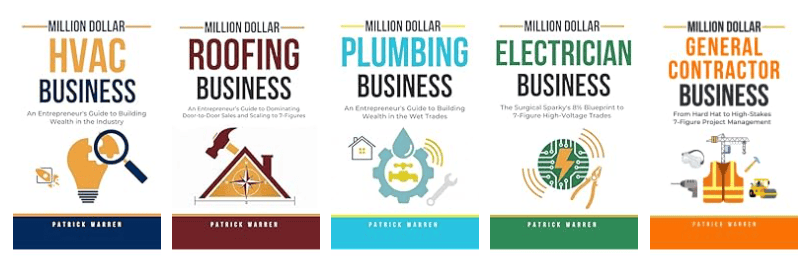
If you recognize those three pain points, you have two choices: You can continue to “grind it out” and let these parasites eat your margin, or you can elevate your game. The ceiling of the “Specialized Sub” is that your income is always tied to your own tools. In the Sovereign Series, we spent months detailing how to dominate the Electrical, Roofing, and Plumbing sectors.
But the real “Trades-to-Wealth” goal isn’t to be the best specialist; it’s to build an Ecosystem where the specialists are working for you. This requires moving from the “Tool Belt” and into the Boardroom.
Today, we are officially announcing the release of Volume V: The Million Dollar General Contractor Business. This isn’t “another book.”
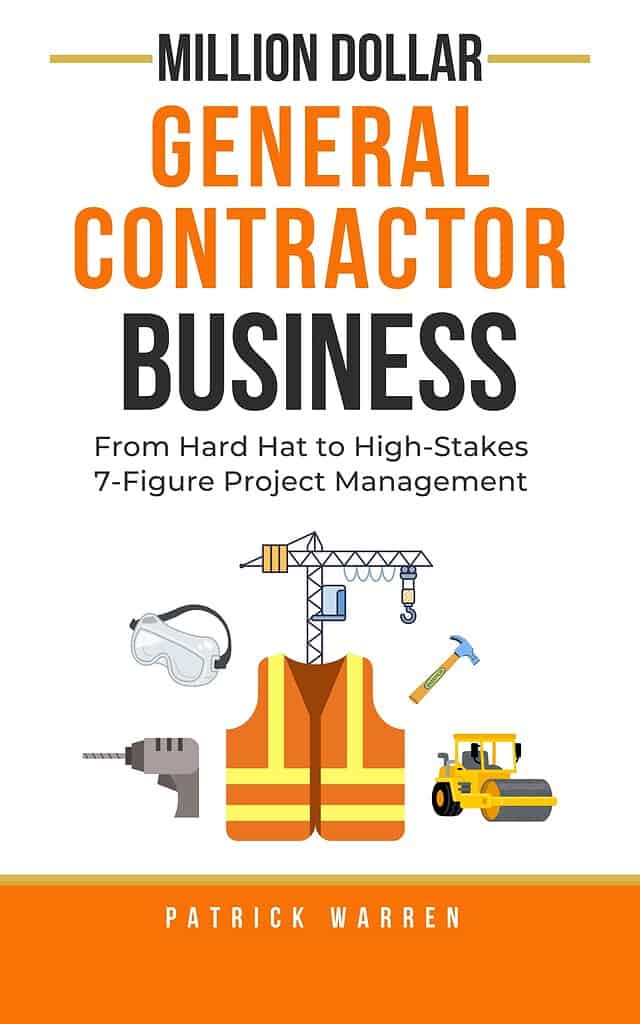
High-Level Strategy for Trades That Demand a Tactician
This is the Command Center. It’s the “PITA Elimination Protocol.” We pull back the curtain on how elite operators use high-level SIGINT (Signal Intelligence) to move from being a “Stress Sponge” to becoming a Project Architect. This graduation manual provides the Operational Discipline required to solve the very problems we just identified:
- Scope Creep Removal: Building bulletproof Change Order Systems.
- The “Sub” Shield: Architecting a high-performance network that delivers on time.
- Cash Flow Command: Designing business models that guarantee a Sovereign Margin.
If you’ve been following the Million Dollar Trades series for your specific trade, you know we don’t do “fluff.” We do Tactical Intel. Volume V is the culmination of the “8% League” philosophy. It’s time to stop “working in” the business and start “commanding” the market.
Don’t just survive the project—Own the project.
The Sovereign Pivot: Why Every “Specialized” Pro Must Eventually Become a Project Architect
Most tradesmen are taught to be masters of a single circuit. You learn the code, you master the tool, and you trade your hours for a highly skilled wage. In the Sovereign Series, we’ve spent months detailing how to dominate the Electrical, Roofing, and Plumbing sectors.
But there comes a day in every elite operator’s career where they hit the “Capacity Wall.” You can only turn so many wrenches. You can only climb so many ladders. If your income is tied to your physical presence on a job site, you aren’t an owner—you’re a high-level employee of your own ambition.
Adept Subcontractor Management Tips
After the release of Volume 4, which is geared towards electricians, in Volume V, we pull back the curtain on the “Project Architect” mindset. We move beyond the “Tool Belt” and into the Boardroom. We tackle the high-level SIGINT (Signal Intelligence) required to run a 7-figure operation:
- The Ecosystem Logic: How to stop “hunting” for jobs and start “architecting” entire developments.
- The Liability Shield: How to protect your assets while managing multi-trade complexity.
- The Sovereign Margin: Why the GC makes the most money while often doing the least “physical” labor.
The Complete Fleet With the release of Volume V, the Sovereign Series is officially complete. We’ve built the foundation in the trades, and now we’ve provided the roof.
Check it out and eliminate any holes in your GC armor to start earning higher bids and better jobs.

- The HVAC Expiration Date: Why Your Back Will Give Out Before Your Ambition Does - March 18, 2026
- The Three Silent “Profit Parasites” Draining Your General Contracting Business (And How to Remove Them) - March 9, 2026
- Bot-Nets and Burnout: My Experience Producing Almost 1,000 Listings for Sage Zaree’s Rehab.com - March 7, 2026